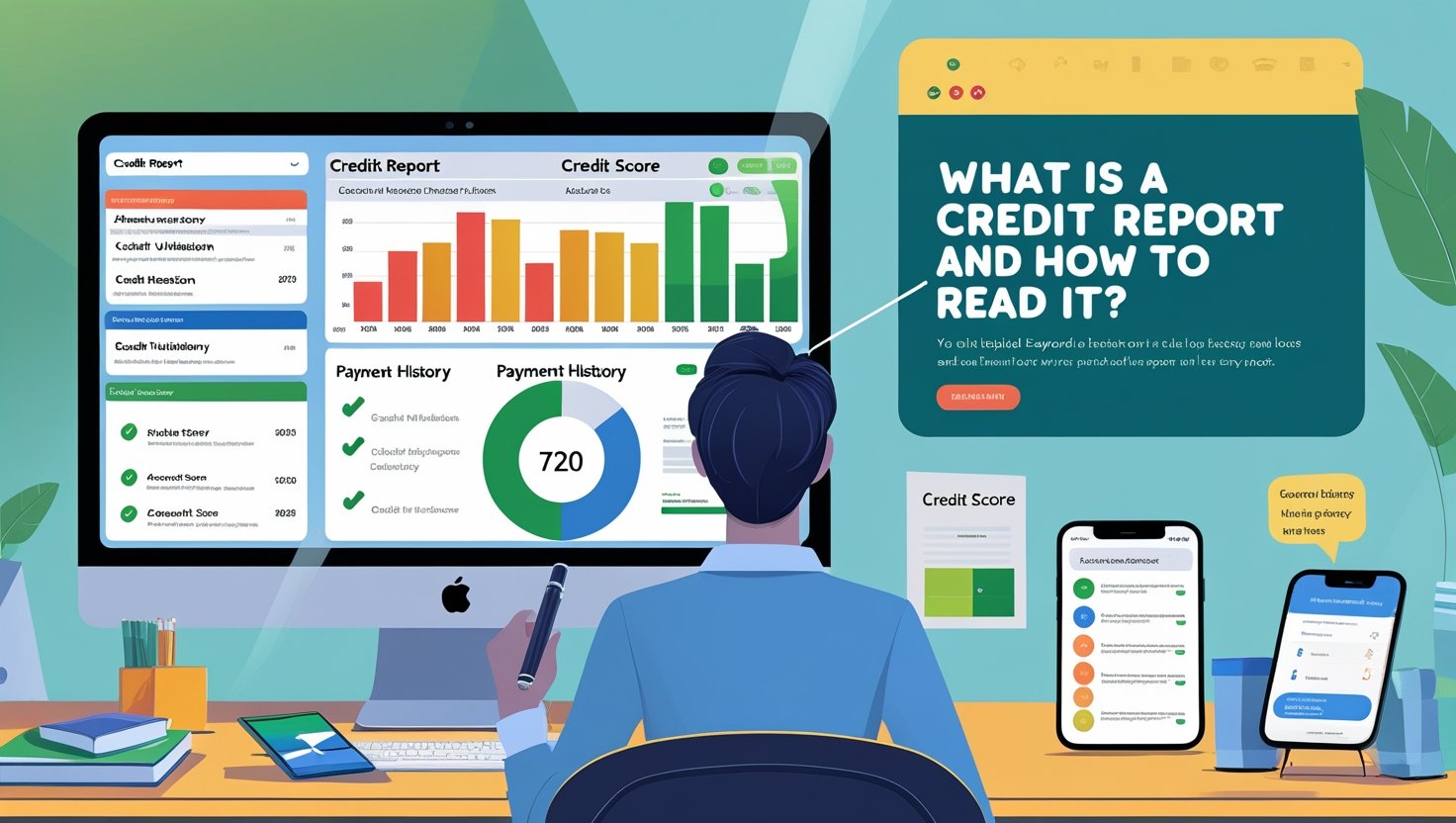
A credit report is a detailed record that shows your financial history. This report tells you from which banks or financial institutions you have taken a loan or credit card to date, how many times you made a payment, when it was late, and what your balance is now. This report is prepared by credit bureaus, which are independent agencies such as Equifax, TransUnion, and Experian. Their job is to collect updated credit data of every individual and then give it to the banks or any lender whenever someone applies for a loan or credit card. The credit report is important because it decides whether you will get a loan or not, and at what rate. If the report is strong, then the bank or lender will give you a loan easily.
Yes, and if the report shows late payments or default, then it becomes difficult to get a loan. Every person should check their credit report at least once a year so that if there is any mistake, they can correct it in time. Nowadays free credit report is available on online platforms; hence, it is important to be aware of what it is and how it keeps you financially safe. From this introduction, one should understand that a credit report is a reflection of your financial image, and everyone needs to understand this.
Key Components of a Credit Report
A credit report is made up of several important sections, and if you understand this, it becomes easy for you to read the report. First of all, it contains personal information, which includes your name, address, date of birth, and sometimes employment details. It is very important to verify in this section that all the details are correct. The second important part is the account information. Here, there is a complete record of your current and past credit cards, loans, mortgages, etc. Which account was opened, and when was it closed?
What was the limit, and what was the payment history?
The third part is the payment history, which holds the most weight for lenders. Here, it shows your payment time.
But whether there was any late payment or no default, and by how much, you are late by 30 or 60 days. There is also an Inquiry section where it is written who has seen your credit report. This is divided into soft and hard inquiries, and these also affect your credit score. Collection accounts or derogatory marks are also sometimes shown in the report. If any of your unpaid debts have been given to a collection agency, it is important to understand all these sections because if there is a mistake somewhere, it is your right to correct it, and this report establishes your financial credibility.
How to Obtain Your Credit Report:
Now let’s talk about how you can obtain your credit report. Earlier, people did not know how to obtain their credit report, but now, as per the law, you can get at least one free credit report every year. In America, AnnualCreditReport.com is an official website from which you can obtain Equifax, TransUnion, and Experian reports together or separately. Apart from this, many private financial apps also provide free credit reports, but it is important to verify their data. While obtaining the credit report, you have to prove your identity, such as your social security number, address, and answer some security questions. The part is, this process is easy, and it is completed online within 5-10 minutes.
When you get the report, first of all, look at it carefully and check all the sections to see if all the information is correct or not. If you feel that there is any account in your report that is not yours or any payment status that is showing wrong, then note it immediately, and the next step is to file a dispute. It is very important to check the credit report once a year so that you can understand your financial health and if there is any fraud or identity theft, then catch it on time. This is a responsible and aware financial habit that every person should learn.
How to Read and Understand Each Section:
After taking the credit report, the most important thing is to read it properly. The first section is personal information, which contains your name, address, and date of birth. It is important to check that everything is correct because if it is wrong, other sections can also be affected. After that, focus on the account information. See which credit cards or loans are listed. Check their limit, balance, and payment status. If any account is not yours, it could be a fraud or identity theft. The payment history section is the most important. Read it in detail. See if there is any late payment or default anywhere.
The reality is written in it. If you have never made a late payment and it is appearing in the report, then note it immediately. Also, check the Inquiries section to see who has seen your report. If there is any such inquiry that you did not initiate, it could be suspicious. Also, check the Collections and Derogatory marks. If any unpaid debt is showing that you do not know, then confirm it. Look at everything in the report calmly, and if required, get it understood from an expert or financial advisor. Understanding the credit report is not difficult if you focus step by step. By understanding the report correctly, you can improve your credit score, and you know. Which area needs to be improved?
Common Errors to Look Out for and How to Dispute Them:
It is common to have mistakes in your credit report, so it is important that whenever you look at your report, you look carefully to ensure that there are no errors. The most common mistake is in personal information, such as the wrong spelling of name, address, or date of birth. Another common mistake is wrong account information. Sometimes, someone else’s account mistakenly appears in your report, which happens due to an identity mix-up. Payment status can also be shown wrong, such as showing late or default despite timely payments. Such errors negatively affect your credit score, so they should not be ignored.
If you find any mistake, first of all, you must submit proof, like bank statements or payment receipts. Then you must send a written dispute letter to the credit bureau, or you can also file it online. Every bureau has its dispute process, which gives the result mostly within 30 days. If the dispute is valid, they correct the mistake, and you get an updated report. You must be polite and clear while filing the dispute, and must attach all the documents. If needed, you can also seek help from the consumer protection agency. By correcting these errors on time, you can avoid problems in taking a loan or applying for a credit card in the future.
Conclusion:
After all, every person must understand that their credit report is a very important part of their financial future. If you understand this and check it on time, you can avoid any mistake, fraud, or identity theft. And if your credit score is low, you will know in which areas you can work to improve your score. Nowadays, it is a time of competition. Everyone wants a loan or a credit card, but banks give them only to those whose credit report is strong. Therefore, ignoring it or not checking it is a big mistake. At least once a year, you should check your credit report once a year.
Make sure to check your credit report, and if there is any issue, resolve it quickly. This is a responsible and smart approach that makes you financially strong. The more you are aware of your financial data, the less stress you will have, and you will be able to easily obtain loans or financing for your big goals. The main purpose of this conclusion is that being proactive and informed is the best way to keep your credit report correct and safe.
FAQs:
Q1: What is a credit report and why is it important?
A credit report is a detailed record of your financial history, showing information like your loans, credit cards, payment history, and current balances. It is prepared by credit bureaus such as Equifax, TransUnion, and Experian. Lenders use this report to decide whether to approve your loan or credit card application and at what interest rate. A good credit report makes it easier to get loans, while a bad report can make it difficult.
Q2: What are the key parts of a credit report?
A credit report usually includes personal information (like your name, address, and date of birth), account information (details of your current and past credit accounts), payment history (showing whether you paid on time or had any late payments), inquiries (who has checked your report), and any collection accounts or derogatory marks (unpaid debts sent to collection agencies). Understanding each part helps you check for mistakes and manage your credit health.
Q3: How can I get my credit report for free?
In the U.S., you can get at least one free credit report every year from each of the three major bureaus through the official site AnnualCreditReport.com. Many private financial apps also offer free reports, but you should verify their accuracy. You’ll need to prove your identity by providing details like your social security number and answering security questions. The process is simple and usually takes a few minutes online.
Q4: What should I check when reading my credit report?
When reading your credit report, first check that your personal information is correct. Then, look at your account information to make sure all listed accounts are yours and that the payment history is accurate. Check the Inquiries section to confirm who has seen your report. Also, look for any collection accounts or derogatory marks that don’t belong to you. If you find anything wrong, make a note of it immediately.
Q5: What can I do if I find an error on my credit report?
If you find a mistake, gather proof like bank statements or payment receipts. Then, file a dispute with the credit bureau—this can be done online or by sending a written letter with your documents attached. Bureaus usually resolve disputes within 30 days and correct valid errors. If needed, you can also get help from a consumer protection agency. Correcting errors quickly keeps your credit report healthy and prevents problems when applying for loans or credit cards.
